
CISA Outlines Top Cybersecurity Challenges for 2026
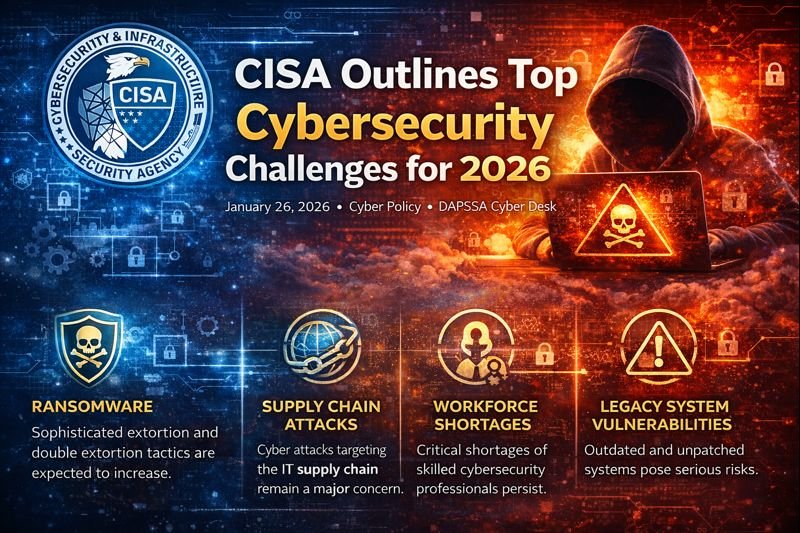
The U.S. Cybersecurity and Infrastructure Security Agency (CISA) has released a comprehensive report identifying the most critical cybersecurity challenges expected to shape the global threat landscape in 2026. The report underscores a growing convergence of technical vulnerabilities, human factors, and systemic risks that threaten both public and private sector resilience.
As digital transformation accelerates across government agencies, critical infrastructure, and enterprises, CISA warns that adversaries are becoming more sophisticated, better funded, and increasingly capable of exploiting interconnected systems at scale.
Rising Threat of Ransomware and Extortion Campaigns
Ransomware continues to be one of the most disruptive and financially damaging cyber threats worldwide. CISA notes that ransomware groups are evolving beyond basic encryption attacks into multi-stage extortion campaigns that include data theft, public leaks, and denial-of-service tactics.
Key concerns include:
- Increased targeting of healthcare, energy, and transportation sectors
- Use of ransomware-as-a-service (RaaS) models by cybercriminal groups
- Blurred lines between financially motivated actors and nation-state proxies
CISA emphasizes that ransomware is no longer just a criminal issue—it is a national security concern.
Supply Chain Attacks Remain a Critical Weak Point
The report highlights software and hardware supply chains as one of the most attractive attack vectors for adversaries. Compromising a single trusted vendor can provide attackers with access to thousands of downstream organizations.
CISA warns that:
- Open-source dependencies are frequently exploited
- Third-party vendors often lack consistent security standards
- Visibility into supplier risk remains limited for many organizations
The agency urges organizations to adopt software bill of materials (SBOMs), stronger vendor risk assessments, and continuous supply chain monitoring.
Cybersecurity Workforce Shortages
A persistent shortage of skilled cybersecurity professionals continues to weaken defensive capabilities across industries. According to CISA, many organizations lack sufficient staff to detect, respond to, and recover from cyber incidents effectively.
Key workforce challenges include:
- Burnout among security professionals
- Limited access to advanced training and certifications
- Difficulty attracting talent to public sector roles
CISA stresses the need for long-term workforce development strategies, including education partnerships, reskilling programs, and diversity initiatives.
Legacy Systems and Technical Debt
Legacy infrastructure remains a major obstacle to improving national cyber resilience. Many critical systems were not designed with modern threat models in mind, making them difficult to secure and expensive to replace.
The report identifies risks such as:
- Unsupported operating systems and hardware
- Inability to apply timely security patches
- Lack of visibility and monitoring capabilities
CISA warns that attackers increasingly target outdated systems because they offer predictable and exploitable weaknesses.
Importance of Public-Private Collaboration
One of the strongest themes in the report is the need for deeper collaboration between government agencies and the private sector. CISA emphasizes that no single organization can defend against modern cyber threats alone.
Priority areas for collaboration include:
- Real-time threat intelligence sharing
- Joint incident response exercises
- Coordinated vulnerability disclosure programs
The agency views trust-based partnerships as essential to improving collective cyber defense.
Strengthening Cyber Hygiene and Awareness
CISA reiterates that basic cyber hygiene remains one of the most effective defenses against large-scale attacks. Despite advances in security technology, many incidents still result from preventable issues.
Recommended practices include:
- Regular patching and vulnerability management
- Multi-factor authentication adoption
- Security awareness training for employees
- Continuous monitoring and logging
The agency stresses that human behavior remains a critical factor in cybersecurity outcomes.
Implications for Governments and Enterprises
The report serves as a clear warning for policymakers and business leaders. As cyber threats grow in scale and impact, organizations must shift from reactive security models to proactive, risk-driven strategies.
Failure to address systemic weaknesses could lead to:
- Disruption of critical services
- Economic losses and reputational damage
- Increased national security risks
CISA urges organizations to treat cybersecurity as a core business and governance issue—not just an IT function.
Final Thought
CISA’s 2026 cybersecurity outlook makes one message clear: the future of cyber defense depends on preparation, collaboration, and accountability. As attackers continue to innovate, defenders must do the same—by investing in people, modernizing infrastructure, and strengthening trust across the digital ecosystem. The organizations that act today will be the ones best positioned to withstand the cyber threats of tomorrow.